by
Armand Cabrera
The images for this article are from one of my demos at the Acadia Workshop I taught out near Bass Harbor. I demo everyday in my workshops so the students can see how I solve problems not just hear me talk about it.
Gail Ribas the owner of Acadia Workshops has a great venue and the locations are all beautiful. She has a big well lit studio for inclement days. We had a class of 9 students. We’ve scheduled another class for next fall, Sept 19-23 and I already have a couple of students planning to be there.
For me, the trip was a dream come true, on the way up I stayed in Gloucester for two nights near Rocky Neck. I had perfect weather and got a painting in the one full day I was there. I visited the Cape Ann Museum and and got some pictures of motiff number one in Rockport so I can do my painting of it at a later date.
Stapleton Kearns was very helpful suggesting places to visit. Once in Maine I actually got to meet Stapleton one evening after my class and he let me hang out with him and his group while they were painting in Acadia Park.
This demo is from Charlotte Rhoades Park in Southwest Harbor five minutes from the workshop center.I want to thank Wyn Easton for taking these photos of me during the painting process. Diane is always after me to photograph my demos but I can demo and talk or demo and photograph but I can't demo, talk and photograph at the same time.
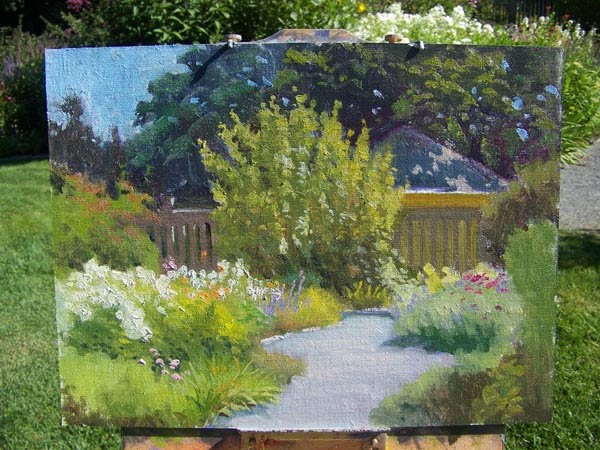
The garden club has a beautiful butterfly garden in full bloom and I always find it a treat to paint. The challenge is to not get lost in too much detail and preserve the big divisions of light and shadow in the scene. This kind of motif can easily be distracting because of all of the saturated color and lack of solid forms.
I spent a few minutes observing and deciding what I was going to move around for my painting and how I would place the elements I wanted in the image.
I started with a simple contour drawing of the big masses as I saw them.
I then blocked in the average shadows being sensitive to hue changes for the different plants and shrubs.
I continue to block all the big shapes in preserving their relative brightness to sun and shadow.
At the very last stages of the painting I refine shapes, adjust values and add the flowers and some detail being careful not to lose the lights. The biggest mistake I see people make painting scenes like this is they get confused by the blooms and fail to preserve their sense of light.
The finished painting 'Butterfly Garden' 12x16 oil on linen painting time two hours.
Variety in Painting
by
Variety creates interest it can be used to move the eye through a painting and its complexity is endless. To see variety you must make yourself aware of the differences between pictorial elements that share similar traits but have a unique quality that creates their individuality. A successful artist can reveal subtle differences that most people over look.
Variety can be created in a number of ways within your image, you can vary the size (contour, height and width) of elements in your scene you can vary their coloring or their angle or spacing to each other. All of these changes add interest and they can be designed into the painting once an artist learns to see them.
Variety can also be added through brushwork and surface quality. Some passages can be painted thinly some with thicker paint. The calligraphy of the brushstrokes can be varied so no two are the same in direction or size.
Edges are another area that gives an artist many opportunities for variety. Edges can be soft or hard optically or they can be physically blended or left sharp and unblended.
Adding this kind of interest insures the painting has lasting appeal beyond the attention of the image itself. Although the subject matter in the image is what draws many people to a particular painting eventually it is the structure and handling of the painting that gives a work power and separates it from current fads or cliché. It is the strength of the design that allows it to stand the test of time.
Armand Cabrera
Artists are always asking about how to improve their painting. I think one of the best things an artist can do to improve is become aware of the variety in everything they paint.
Variety can be created in a number of ways within your image, you can vary the size (contour, height and width) of elements in your scene you can vary their coloring or their angle or spacing to each other. All of these changes add interest and they can be designed into the painting once an artist learns to see them.
Variety can also be added through brushwork and surface quality. Some passages can be painted thinly some with thicker paint. The calligraphy of the brushstrokes can be varied so no two are the same in direction or size.
Edges are another area that gives an artist many opportunities for variety. Edges can be soft or hard optically or they can be physically blended or left sharp and unblended.
Adding this kind of interest insures the painting has lasting appeal beyond the attention of the image itself. Although the subject matter in the image is what draws many people to a particular painting eventually it is the structure and handling of the painting that gives a work power and separates it from current fads or cliché. It is the strength of the design that allows it to stand the test of time.
All paintings for this article by Willard Leroy Metcalf
Subscribe to:
Posts (Atom)