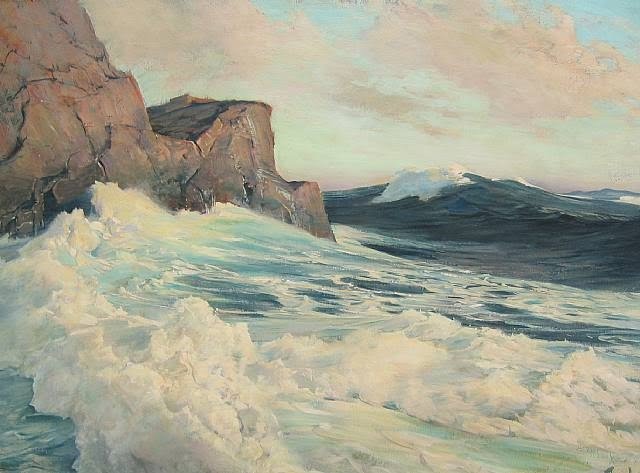
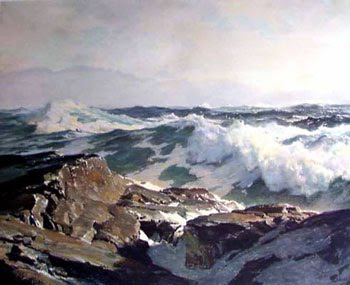
These are the rest of Frederick Judd Waughs notes on Marine Painting. I highly recommend the biography on his life written by George R Havens published in 1969, if you can find a copy.
I find to paint the sea in a modernistic way, something is lacking, just because in this case, subject counts. The sea to my way of thinking should look like the sea.
Of course to paint the sea on the spot is good- very good- but at its best it is confusing. At first one is inclined to paint every sort of wave which comes, dropping the one which has been laid in for another one. Soon however the attention becomes riveted upon one peculiarly attractive phase and you look for repetitions of it until by degrees you have worked it out.
So I, when I paint waves from nature, make up my mind what composition in drawing I will undertake, and stick to that one rigidly until the end, no matter what other composition comes forward to claim my attention. This continual watching for repetitions in the anatomy of the sea is no end of a help to the student. If however you cannot go to the sea, how on earth do you expect to paint marines? There is no textbook on the subject which can give you the same insight as the sea itself- nor will pictures do so entirely. Photographs are incorrect, in that the color and values are wrong…
In general, all waves must have weight body color which is varied in tone, light and shadow. They have bulging curves. Leave the sharp edges to the rocks especially for contrast. A wave is carried forward by the weight behind it until reaching the shallow water where the directing power of the sand forces the top to fall over. The expanding shut-in air breaks into foam. The wave continues to rush forward and part of the foam is left behind by the back force which forms innumerable patterns.
The sea itself is very subtle in color and ever changing, you must learn by heart these subtleties, if you want to do it well. You cannot throw a few daubs of paint and expect to find the sea painted in a convincing manner. I say that if the sea is to be painted in a worthwhile manner, the painter must study it from nature each part of the year, until the time arrives when they can paint it quite well from memory as from the real.
It is a good plan to begin by looking at the general tone of the sea as compared with the sky, and striving, without painting the details, to paint a single mass of plain water against the sky in its right relation, both in value and color. This also applies to painting the sea against rocks or sand.
I do not pay particular attention to details now but I am glad I used to do so because knowing them intimately aids me to paint broadly with more certainty than if I never studied them.
Finally it is better to err upon the side of loose, ragged painting than upon the side of tight, close hard, finished painting. Nevertheless everyone should study both in line drawing and in mass with color or pencil or charcoal.
Bibliography
Frderick Judd Waugh American Marine Painter
George R Havens
University of Maine Press 1969
Frederick Waugh's Paintings of the Sea
Walter foster book 153
Walter Foster Publishing
Waugh passed away at the age of 79 on September 10 1940 in Provincetown MA. The cross that marks his grave is inscribed with the 19th verse of Psalm 77, it reads
"Thy way is in the sea, and thy path in the great waters, and thy footsteps are not known."
Showing posts with label Frederick Judd Waugh. Show all posts
Frederick Waugh Notes on Marine Painting
By Armand Cabrera
Frederick Waugh is America’s greatest marine painter. He was very successful in his long career. I did a biography on him here for this blog in 2008.
Before he died Waugh had put together a ten chapter book on marine painting. Although the book was never published we have excerpts provided by George Havens at the end of his biography on Waugh written in 1969. These are some of the more generic quotes on painting the sea.
Waugh listed his palette as permalba white, the cadmiums, alizarin, cerulean blue, cobalt blue, ultramarine blue, viridian, raw sienna, burnt sienna and ivory black. He says “My medium for first painting is a little turpentine. Afterwards color as it comes from the tube. If need be, a little oil, but be careful of that.”
• No Doubt the sea is a difficult subject. To paint it convincingly means long, careful observation of its many phases and anatomy, for the sea has anatomy.
• I both paint from the sea and watch it carefully, and the later way of studying I am sure is invaluable.
• Paint as rapidly as possible, I want to stress that the more you can finish as you go the better.
• Simplify, simplify, simplify as much as possible without losing the essential of what is sought
• Look for the big things, art doesn't begin and end in detail. It rather begins in breadth and ends in more breadth, in what you can do without.
• I have always held that with a few exceptions, no two spaces in a picture should be of the same area or shape.
• I find that my most striking pictures of the sea are those strong in contrasts, the shadows as dark as I can get them and everything in between of the proper value all the way up to the highest light I select to use. Walking back to judge the work at a distance preserves its carrying quality and force; I walk back all day long. The carrying quality is given by the accents one puts on the shadows, halftones and highlights. This means full rich painting in proper values.
• A sense of mystery is often conveyed by certain passages which lack obviousness because left unfinished.
• I have always believed in establishing the sky tone, in general, as soon as possible. In sea painting the rest depends upon it because of the element of reflection.
• Observations, concentration then application.
Bibliography
Frederick Judd Waugh American Marine Painter
George R Havens
Univesity of Maine Press 1969
Frederick Waugh is America’s greatest marine painter. He was very successful in his long career. I did a biography on him here for this blog in 2008.
Before he died Waugh had put together a ten chapter book on marine painting. Although the book was never published we have excerpts provided by George Havens at the end of his biography on Waugh written in 1969. These are some of the more generic quotes on painting the sea.
Waugh listed his palette as permalba white, the cadmiums, alizarin, cerulean blue, cobalt blue, ultramarine blue, viridian, raw sienna, burnt sienna and ivory black. He says “My medium for first painting is a little turpentine. Afterwards color as it comes from the tube. If need be, a little oil, but be careful of that.”
• No Doubt the sea is a difficult subject. To paint it convincingly means long, careful observation of its many phases and anatomy, for the sea has anatomy.
• I both paint from the sea and watch it carefully, and the later way of studying I am sure is invaluable.
• Paint as rapidly as possible, I want to stress that the more you can finish as you go the better.
• Simplify, simplify, simplify as much as possible without losing the essential of what is sought
• Look for the big things, art doesn't begin and end in detail. It rather begins in breadth and ends in more breadth, in what you can do without.
• I have always held that with a few exceptions, no two spaces in a picture should be of the same area or shape.
• I find that my most striking pictures of the sea are those strong in contrasts, the shadows as dark as I can get them and everything in between of the proper value all the way up to the highest light I select to use. Walking back to judge the work at a distance preserves its carrying quality and force; I walk back all day long. The carrying quality is given by the accents one puts on the shadows, halftones and highlights. This means full rich painting in proper values.
• A sense of mystery is often conveyed by certain passages which lack obviousness because left unfinished.
• I have always believed in establishing the sky tone, in general, as soon as possible. In sea painting the rest depends upon it because of the element of reflection.
• The result of direct painting, in skillful hands is the best ever. It goes far ahead of labored work, painting after painting, day after day, with perhaps ones mental attitude on the change. I say, if you can grab the whole in one continuous period of time, unaffected by breakfast, lunch, dinner or the evening’s amusements or other preoccupations. One day you may feel one way, the next day may be different. Take hold of the motif, of the technique of the enthusiasm of a whole unbroken day if possible.
• Observations, concentration then application.
Bibliography
Frederick Judd Waugh American Marine Painter
George R Havens
Univesity of Maine Press 1969
Subscribe to:
Posts (Atom)