Showing posts with label 19th century painting. Show all posts

Eleanor Fortescue Brickdale

by
Armand Cabrera


Eleanor Brickdale was the youngest child of a barrister. She began her formal study of art at 17 enrolling in the Crystal Palace School of Art and then the Royal Academy School in London. In 1894 her father was killed in an alpine accident and the family moved to Kensington. She began exhibiting at the Royal Academy in the black and white section starting in 1896 and won a prize for her painting, spring in 1897. That same year she had a feature in The Studio on her work.

The prize money from her award let her concentrate on larger paintings for the Royal Academy shows. Her first large scale oils were shown at the RA in 1899. That same year she illustrated Sir Walter Scotts Ivanhoe. In the summer of that same year she received a commission from London Gallery owners Walter and Charles Dowdeswell for a solo show of watercolors, to be delivered and paid for in quarterly installments over the next two years. The exhibition of forty five pictures opened in 1901. The show was widely reviewed and well praised and all except two paintings were sold.

Brickdale received another article in The Studio in 1901 with eight monochrome and two color pieces written by Walter Shaw Sparrow. The next year Brickdale was the first woman elected to the Institute of Painters in Oils and became an associate member of the Royal Watercolor Society.

More book commissions came in and Brickdale continued to regularly exhibit her watercolors in the bi-annual shows at the Royal Watercolor Society from 1902 and at least one oil painting a year at the Royal Academy. Dowdeswell Galleries renewed their commission for another show of watercolors in 1905. In 1909 Leicester Galleries commissioned a show of 28 works based on Tennyson’s Idylls of the King.

Brickdale and her work continued to be popular and more commissions for book illustrations and gallery shows kept her busy until 1932 when her eyesight began to fail.

Brickdale suffered a stroke in 1938 but continued to show paintings at the Royal Watercolor Society shows until 1942. Eleanor Fortescue Brickdale died in London in 1945 at the age of 73.


Bibliography

Women Artists and the Pre-Raphealite Movement

Jan Marsh and Pamela Gerish Nunn

1989 Virago Press

Surface Quality

by Armand Cabrera


Redmond

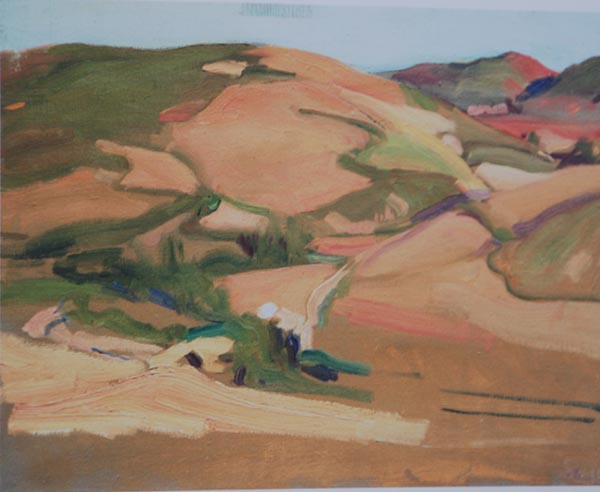
Oil Paintings are more than just good drawing and good color and design. Often the way the paint is applied can be just as important. Once you learn the basics of representational picture making in oils it is important that your work take advantage of all the properties of the paint.

                                                                      Carlson

 
One way of achieving this is the use of paint quality and handling. Imprimatura, scumbling, impasto and glazing all add an extra dimension of interest to traditional work when applied with intelligence and forethought.

                                                                         Wyeth

 
Walk into any museum and look at a representational painting from the impressionist painters or golden age illustrators and you will see the use of all dimensions and properties of the paint at play. Nowhere was this more apparent than at the Howard Pyle show at the Delaware and the concurrent N.C. Wyeth show at the Brandywine Museum. Huge areas of the total canvas rendered with nothing more than a dark imprimatura. Lights loaded with impasto, color glazed and scumbled over other colors instead of blended. In some places the raw weave of the canvas showing through all to great effect.

                                                                          Pyle

 
It’s the same for the impressionists here and abroad at the turn of the 20th century. These artists knew their materials and let the unique properties of each artists chosen medium exert itself in the image. It is this philosophy of fidelity to the paint itself that give these works so much power and beauty.

It is an important lesson to be learned, that a thing has an inherent beauty and purpose. As an artist we must be sensitive enough to recognize those qualities and use them in service of our ideas so that it complements the work and raises it beyond the commonplace.


                                                                           Monet

Sorolla Apuntes

by
Armand Cabrera


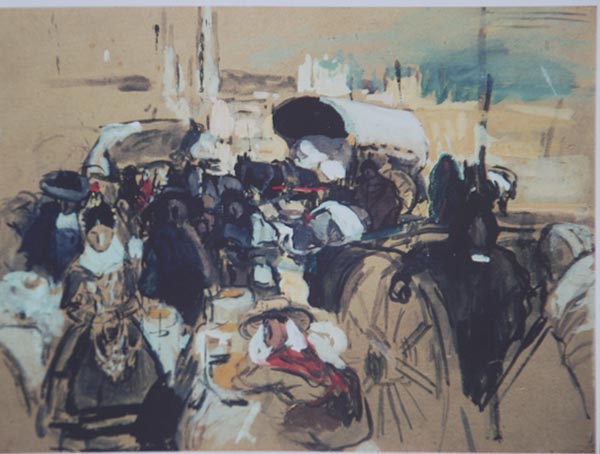
In my opinion, Joaquin Sorolla was one of the greatest painters of the early twentieth century. While I know many readers are familiar with his formal and finished works I thought it would be interesting to post some of his sketches or apuntes as they were called in Spanish. These were quick small notes used as reference for his larger works. Most were painted on cardboard and were 3x5 to 12x16 inches.

These are in the catalog from the show in Spain at the Sorolla Museum. The catalogue is in Spanish but contains 1283 images, most in color of these sketches as well as his larger finished works.


Bibliography

Catalogo de Pintura
Del Museo Sorolla
2010

Henry Ossawa Tanner

By Armand Cabrera


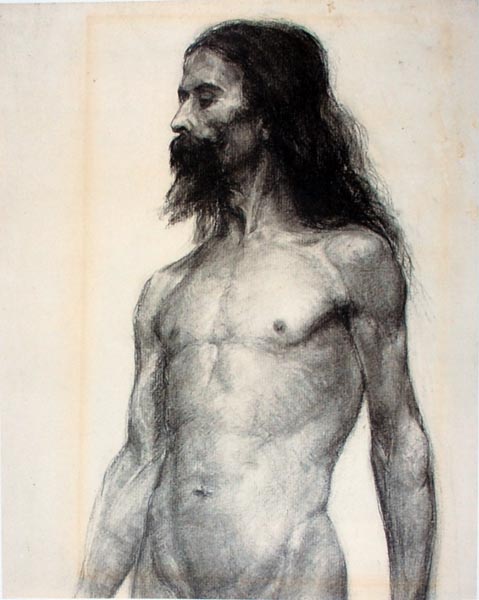
 Henry Ossawa Tanner was born in Pittsburgh Pennsylvania on June 21, 1859. He was the son of a  Bishop in the African Methodist Episcopal Church. Tanner’s family settled in Philadelphia when he was five years old. At thirteen while walking in his neighborhood with his father he saw an artist painting. The young Tanner was so fascinated by the process he decided to become an artist. Tanner studied on his own and with some local artists for the next seven years.


In 1880 at the age of twenty one Tanner enrolled in the Pennsylvania Academy of the Arts and studied under Thomas Eakins and Thomas Hovenden for the next five years. At the academy Eakins gave Tanner the solid training he needed in drawing and painting and Hovenden taught him to infuse his paintings with emotion and sensitivity and to paint from experience. These two complimentary approaches would serve Tanner well as he matured as an artist.


Tanner left the academy before graduation in hopes of creating a successful photography gallery in Atlanta, GA. The endeavor was short lived and he sold the business and moved to the Blue Ridge of North Carolina where he sold photographs and painted.


In 1890, the Hartzells, his best patrons at the time arranged a show of Tanners work in Cincinnati. When the paintings did not sell the Hartzells bought the entire collection. This sale allowed Tanner to continue his studies in Europe.


In 1891 Tanner arrived in Paris and enrolled in the Academie Julian. Here Tanner studied under Jean Paul Laurens and Jean Joseph Benjamin Constant. In the summers Tanner spent time in Concarneau in Brittany at the American art colony there.


In 1894 Tanner had his painting The Banjo Lesson accepted into the Paris Salon. For the next twenty years he would have a painting accepted every year in the Salon. In 1895 Tanner won an honorable mention from the Salon for his painting, Daniel in the Lion’s Den. In 1897 he was awarded a third class medal from the Salon for The resurrection of Lazarus and the painting was purchased by the French Government. After 1897 Tanners work became more personal and his brushwork and color more post impressionistic. He developed a unique approach that mixed the modernism of the time with a solid academic foundation.


Tanner began to explore more religious themes after his success at the Salon. He infuses a sense of place and great emotional impact in these large canvases. They have a powerful authenticity that is usually lacking in this type of subject matter. His characters are not painted as the safe clichéd blond European bourgeoisie in robes walking through candy colored gardens. Tanner’s scenes are the real world experiencing the bibles miracles and by painting them as such they heighten the sense of the Divine for the viewer.


In 1921 Tanner was awarded the Cross of the Legion of Honor, The highest honor the French government bestows on nonmilitary personnel.


Tanner should be remembered as a great American painter for his accomplishments as an artist but it is also the courage it took for him to achieve his success as an African American man at the end of the nineteenth century that stands out from other painters of that time. Wherever he travelled in America he was controlled by the separate but equal laws of the time, especially in the southern states. The Pennsylvania Academy accepted him on the strength of his work but then delayed his entrance when they found out his race. He constantly suffered racial attacks by other students of his class at the Academy. Joseph Pennell was part of a group of racist students that tied Tanner to his easel and then left him outside in the middle of the street when Tanners ability quickly began to eclipse theirs. He constantly fought to be recognized for his ability alone and to eschew being tied to any type of racial style or aesthetic. His treatment in America was severe enough that he lived most of his life in France.


Henry Ossawa Tanner died in Paris, France in 1937.


Bibliography

Henry Ossawa Tanner
Philadelphia Museum of Art
Rizzoli Publishers 1992


Quote

My effort has not only been to put the Biblical Incident into the original setting but at the same time to give the human touch which makes the whole world kin and whichever remains the same while giving truth of detail not to lose sight of important matters- by this I mean that of color and design should be as carefully thought out as if the subject had only these qualities. To me it seems no handicap to have a subject of nobility worthy of ones best continued effort. There is but one thing more important than these qualities, and that is to try and convey to the public the reverence and elevation these subjects impart to you, which is the primary cause of their choice. ~ Henry Ossawa Tanner