Showing posts with label european painting. Show all posts

Eleanor Fortescue Brickdale

by
Armand Cabrera


Eleanor Brickdale was the youngest child of a barrister. She began her formal study of art at 17 enrolling in the Crystal Palace School of Art and then the Royal Academy School in London. In 1894 her father was killed in an alpine accident and the family moved to Kensington. She began exhibiting at the Royal Academy in the black and white section starting in 1896 and won a prize for her painting, spring in 1897. That same year she had a feature in The Studio on her work.

The prize money from her award let her concentrate on larger paintings for the Royal Academy shows. Her first large scale oils were shown at the RA in 1899. That same year she illustrated Sir Walter Scotts Ivanhoe. In the summer of that same year she received a commission from London Gallery owners Walter and Charles Dowdeswell for a solo show of watercolors, to be delivered and paid for in quarterly installments over the next two years. The exhibition of forty five pictures opened in 1901. The show was widely reviewed and well praised and all except two paintings were sold.

Brickdale received another article in The Studio in 1901 with eight monochrome and two color pieces written by Walter Shaw Sparrow. The next year Brickdale was the first woman elected to the Institute of Painters in Oils and became an associate member of the Royal Watercolor Society.

More book commissions came in and Brickdale continued to regularly exhibit her watercolors in the bi-annual shows at the Royal Watercolor Society from 1902 and at least one oil painting a year at the Royal Academy. Dowdeswell Galleries renewed their commission for another show of watercolors in 1905. In 1909 Leicester Galleries commissioned a show of 28 works based on Tennyson’s Idylls of the King.

Brickdale and her work continued to be popular and more commissions for book illustrations and gallery shows kept her busy until 1932 when her eyesight began to fail.

Brickdale suffered a stroke in 1938 but continued to show paintings at the Royal Watercolor Society shows until 1942. Eleanor Fortescue Brickdale died in London in 1945 at the age of 73.


Bibliography

Women Artists and the Pre-Raphealite Movement

Jan Marsh and Pamela Gerish Nunn

1989 Virago Press

Sorolla Apuntes

by
Armand Cabrera


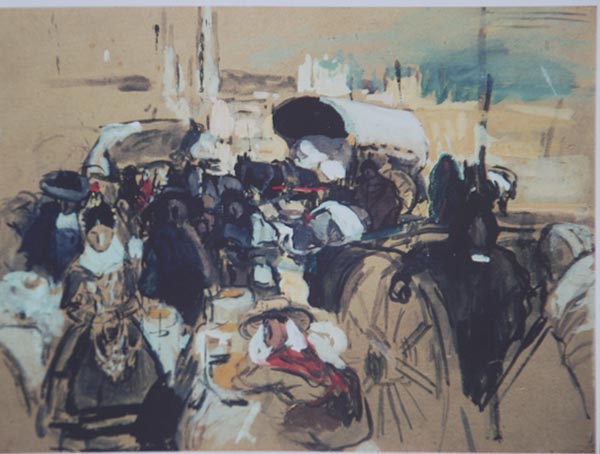
In my opinion, Joaquin Sorolla was one of the greatest painters of the early twentieth century. While I know many readers are familiar with his formal and finished works I thought it would be interesting to post some of his sketches or apuntes as they were called in Spanish. These were quick small notes used as reference for his larger works. Most were painted on cardboard and were 3x5 to 12x16 inches.

These are in the catalog from the show in Spain at the Sorolla Museum. The catalogue is in Spanish but contains 1283 images, most in color of these sketches as well as his larger finished works.


Bibliography

Catalogo de Pintura
Del Museo Sorolla
2010

Henri Fantin Latour

By Armand Cabrera


Ignace Henri Jean Theodore Fantin-Latour was born in 1836 in the town of Grenoble France. His Father was a pastel artist. Henri studied drawing with his father at age ten. At fourteen he studied under Lecocq de boisbaudran for six years at the Petite Ecole de Dessin in Paris. Latour attended the Ecole des Beaux-Arts but was expelled after three months for showing no signs of improvement. After his training he began making master copies in the Louvre for twelve years. The practice was an almost daily obsession.

It is in the Louvre that he met many artists including Edouard Manet, Berthe Morisot and James Abbott McNeill Whistler. It was Whistler that introduced him to important English patrons and this is where Latour found a lifelong market for his still life paintings.


He exhibited with the Salon between 1861 and 1899. He also exhibited in the Salon de Refuses in 1863 but refused to show with the Impressionists. In 1878 Latour received a medal at the Salon and the Cross of the Legion of Honor. He was a prolific painter producing 2500 paintings in his lifetime. Nearly a quarter of them were still life paintings and most of his paintings were created in a twenty year period from 1870 to 1890. Besides still life paintings he also painted portraits and figurative work.


Toward the end of his life he looked upon still life painting as forced labor but it was so lucrative he could not give them up. Henri Fantin Latour died in 1904 at the age of 68


Bibliography

Henri Fantin Latour
Edward Lucie-Smith
Rizzoli 1977

The Impressionist Still Life
Eliza E. Rathbone and George T.M. Shackelford
Harry N. Abrams 2001


Quote

I tried to make a painting representing things as they are found in nature; I put a great deal of thought into the arrangement, but with the idea of making it look like a natural arrangement of random objects. This is an idea that I have been mulling over a great deal; giving the appearance of a total lack of artistry~ Henri Fantin Latour

Knowledge versus Formula

by Armand Cabrera

As artists we constantly strive for truth and originality in our work but to do so requires many incidental pieces of knowledge, some experiential or practical and some theoretical or constructive.

The best painters use the knowledge they have obtained as an outline or guidepost for the efforts, many times adding their own unique perspective to age old fundamentals.

We must all beware of the trap knowledge brings which is a formulaic approach to painting. The phrase formula painter gets bandied about a lot, especially when someone hits their stride stylistically and makes some subject matter their own.

Many times it is used to marginalize the success of that painter as if the mere fact of their success has tainted the purity of the work. The painter has sold out in the eyes of their contemporaries.

In my mind it is not about success or having “made it” whatever that means. To me formula is less than a best attempt, where an artist will rely on convention and ability to get them through, but not breaking a sweat with the effort put forward. This is not tied to style or subject; many non-objective painters fall into this trap and in my opinion they do it more often than representational painters do.

I don’t really mind the exploration of a theme as Monet did with his haystacks or paintings of Rouen Cathedral where his focus was not so much the subject itself but the exploration of light and atmosphere and how that affects our perception some familiar thing. In these cases the motif is the anchor for the viewer and the different canvases challenge our experiences.

Some painters like John Fabian Carlson or Fritz Thaulow explored an area of the country over and over again but each time, the experience was captured with a fresh eye and keen observational skills. The unique experience of that time and place is what the painter was after.


The line is crossed though when nothing is being added to the original idea. There is no transition from one canvas to the next, except the movement of the pieces of the design. It becomes an endless assembly line of the familiar and the banal. The artist explores nothing but the tolerance of their audience to suffer through the same thing for as long as the artist can sell canvases.


A great artist keeps their fire and passion for their work, and while being human allows them some leeway in difficult times of their careers; overall, they approach each painting as a student, seeking knowledge and truth from the places they know and love. This is what makes great art.


Images for this article, first five, Claude Monet, next two John Fabian Carlson, last three Fritz Thaulow. All copyrights are wth the families or institutions that hold the paintings.