Showing posts with label american luminists. Show all posts

Thomas Worthington Whittredge

by Armand Cabrera


Thomas Worthington Whittredge was born in 1820 on his family’s farm near Springfield, Ohio. His father was a retired sea captain. The family had moved from Massachusetts in 1817 and settled on the little Miami River. Whittredge’s education was extremely limited; most of his time was spent working the farm as a child and trapping animals for their pelts. Whittredge asked his father to leave home at 17 and with his father’s blessing he moved to Cincinnati, Ohio to serve as an apprentice house and sign painter to his sister’s husband.

As a sign painter he learned to draw and letter and was soon creating pictures for all types of signs and banners. He later tried his hand running a daguerreotype studio in Indianapolis, Indiana, to disastrous results that left him broke and sick and was taken in by Henry Ward Beecher and Harriet Beecher Stowe who wrote Uncle Tom’s Cabin. For helping him recover, Whittredge painted portraits of the Beecher family members.

In 1843 Whittredge decided to pursue landscape painting, and secured lines of credit against the paintings he would make abroad. In 1849 he traveled to Düsseldorf, Germany, to further his training at the Düsseldorf Academy. He received informal training from landscape painter Andreas Achenbach and became friends with Carl Friedrich Lessing. Whittredge travelled through Europe and sketched with Albert Bierstadt staying for 4 years in Rome where they were joined by Sanford Robinson Gifford and William Stanley Haseltine.

In 1859 Whittredge returned to America to live in New York City. He rented a space in the now famous Tenth Street Studio Building. Whittredge sought a unique approach for his American landscapes. He turned to nature and he began painting the Catskills and along the Hudson River with his friends Sanford Gifford and Gervis McEntee. Other painters were also pursuing an American aesthetic they were John Frederick Kensett, Richard Hubbard, George Inness, Alexander Wyant John Casilear, James Hart, William Hart and of course Frederick Church Asher Durand and Albert Bierstadt. These artists came to be known as the Hudson River School.

Just before the outbreak of the Civil War in 1860 Whittredge was elected to the National Academy of Design and becoming a full member in 1862. Whittredge tried to inlist in the war but was turned away. During the war he worked to help raise money and make clothes for the troops. He became President of the National Academy of Design from 1874 to 1877.

In 1865 Whittredge accompanied General Pope on a tour of the Missouri Territory, the Eastern Rockies and New Mexico. Worthington married in 1868. In 1880 bought some land and built a house for his family in Summit, New Jersey. In the 1890’s Whittredge began writing his autobiography which he completed in 1905. Thomas Worthington Whittredge died three months before his ninetieth birthday in 1910.


Bibliography


The Autobiography of Worthington Whittredge 1820-1910
Edited by John I. H. Baur
1969 Arno Press


Techniques of the Artists of the American West
Peggy Samuels
1990 Wellfleet Press


Quote

A landscape painter is only at home when he is out of doors. It matters not whether he is an Impressionist or one of the older schools who dwelt with more rigors on form and outline.~ Thomas Worthington Whittredge

Moonlight

by
Armand Cabrera


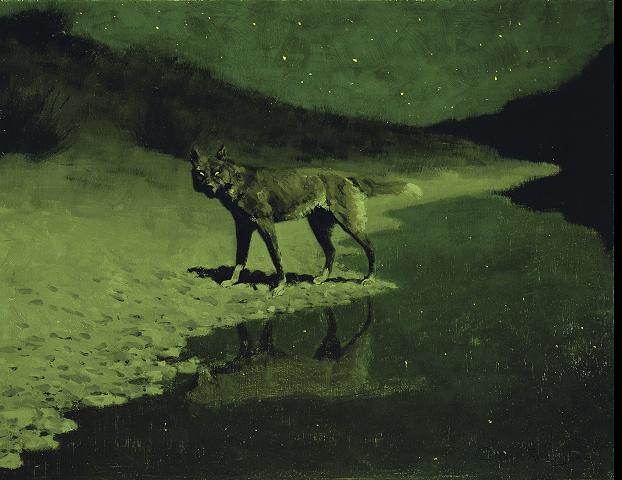
Painting moonlight is not something people do much these days but I thought I would address the lighting effects from moonlight anyway. Moonlight is really strong reflected light and because of its weaker source, moonlight appears very cool to our eyes. Like ambient light, you lose the reflected light from other surfaces. The exception is in snow, where a strong enough phase of the moon with a clear sky will give you some reflected light, depending on the angle to the viewer.


The whole value scale is squeezed down to two thirds of the full normal value range. Edges lose their crispness compared to daylight situations and because of these lower values most hues have lower saturations. The cool light, warm shadows adage works well here too. Many painters start with a warm compliment wash of a deep red or yellow before painting the rest of the scene.


In a moonlit sky the light spreads out in prismatic order, this is especially apparent when clouds or fog is present and can add a dramatic effect if you are skilled enough to capture it.


One of the problems with painting at night is, it’s hard to find a good enough light source to paint by. I wear a head lamp that is used for camping and I have a barbecue light I can attach to my painting rig for my palette. It has a c-clamp style base and works well with all my various setups; French easel, pochades or A-frame easel. This way I can have light on my painting and palette at the same time, although I won’t be making any best dressed lists in this getup.


The biggest challenge of painting at night is finding a safe location that allows you to paint but won’t get the cops called on you. Most people think you’re pretty weird when standing around in one place with a headlamp on. If you get too far away from people, you run the risk of being harassed by the lower elements of society.


Too much blue in moonlight scenes seems to make them less effective than if an artist orchestrates his colors and shifts them to the cool end of the spectrum still retaining the reds and yellows and greens with less saturation and lower values. The form principle still applies in moonlight so shadows shift temperature from the lights. Moonlight is directional like sunlight, so the light, even though much weaker than the sun, is not top down and flat as the light on an overcast day.


Paintings in this article from top to bottom, Charles Rollo Peters, Knud Andreassen Baade, Frank Tenney Johnson, George Sotter, George Sotter, Frederick Remington

More on Construction in Painting

by Armand Cabrera

I want to talk more about construction for landscape painters. Figure painters know that construction is an important aspect of their training. With figure drawing and painting you learn the ideal and then adjust and apply the specific to your understanding. This type of training rarely takes place for landscape painters. Landscape painters tend to copy what they see for good or bad. While this approach can work over time, great landscape painters, like great figure painters, understand their subject on a deeper level. Their method is partly based on observation and partly on construction. It is as much from what they know about something as it is about what they see. This combination of construction and observation helps to strengthen the painting.

                                                                          Thomas Moran
 Everything has an anatomy to it; understanding this underlying structure helps you paint with a more authoritative approach. Observation alone can fool the viewer into believing they are seeing something they are not. How many times have we been fooled by some foreshortened object in the landscape thinking something looks a certain way when in reality our view of it is giving us false information? If you understand the anatomy of the thing you are looking at there is little chance for confusion since you can visualize what is going on even when its shape is distorted in your view.


William Wendt

A constructive approach can aid the design and the elegance of your depiction too. It can help with an interpretation based only in part on naturalism. Many great painters have used their understanding of the landscape and flora and fauna to create paintings truthful to nature but utterly unique to that artist. This approach requires a thorough knowledge of the subject, the ability to pick out what’s important and strip away what isn’t. For the artist, it creates a completely personal view of the world irrespective of the subject matter.


Maynard Dixon