Showing posts with label american tonalists. Show all posts

Moonlight

by
Armand Cabrera


Painting moonlight is not something people do much these days but I thought I would address the lighting effects from moonlight anyway. Moonlight is really strong reflected light and because of its weaker source, moonlight appears very cool to our eyes. Like ambient light, you lose the reflected light from other surfaces. The exception is in snow, where a strong enough phase of the moon with a clear sky will give you some reflected light, depending on the angle to the viewer.


The whole value scale is squeezed down to two thirds of the full normal value range. Edges lose their crispness compared to daylight situations and because of these lower values most hues have lower saturations. The cool light, warm shadows adage works well here too. Many painters start with a warm compliment wash of a deep red or yellow before painting the rest of the scene.


In a moonlit sky the light spreads out in prismatic order, this is especially apparent when clouds or fog is present and can add a dramatic effect if you are skilled enough to capture it.


One of the problems with painting at night is, it’s hard to find a good enough light source to paint by. I wear a head lamp that is used for camping and I have a barbecue light I can attach to my painting rig for my palette. It has a c-clamp style base and works well with all my various setups; French easel, pochades or A-frame easel. This way I can have light on my painting and palette at the same time, although I won’t be making any best dressed lists in this getup.


The biggest challenge of painting at night is finding a safe location that allows you to paint but won’t get the cops called on you. Most people think you’re pretty weird when standing around in one place with a headlamp on. If you get too far away from people, you run the risk of being harassed by the lower elements of society.


Too much blue in moonlight scenes seems to make them less effective than if an artist orchestrates his colors and shifts them to the cool end of the spectrum still retaining the reds and yellows and greens with less saturation and lower values. The form principle still applies in moonlight so shadows shift temperature from the lights. Moonlight is directional like sunlight, so the light, even though much weaker than the sun, is not top down and flat as the light on an overcast day.
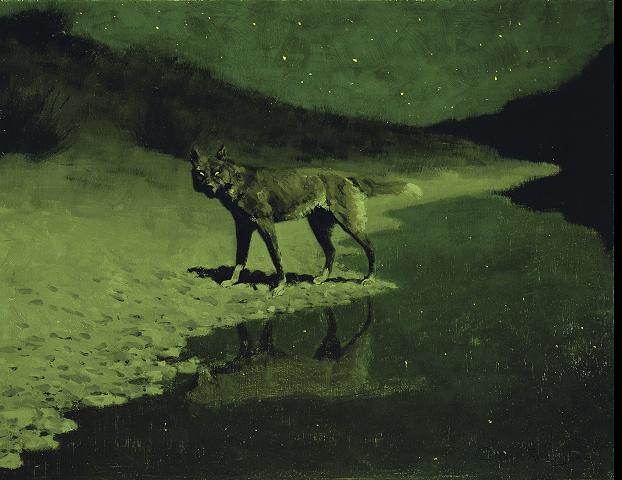

Paintings in this article from top to bottom, Charles Rollo Peters, Knud Andreassen Baade, Frank Tenney Johnson, George Sotter, George Sotter, Frederick Remington

Overcast Light

by
Armand Cabrera


An overcast day loses the direct light source of the sun and with it, most reflected light. When the sun is occluded by clouds or fog this leaves the scene with only ambient light or sky light. The difference is that this light is more neutral than on a sunny day when the color of this light is blue shifted from the sky color without clouds. In this type of lighting the objects have localized shadows and a tint from the cloud cover. Shadows tend to be warmer than they would be in full sunlight. The saying 'cool light warm shadows', applies here and can be used to great effect in this type of scene.


Color transitions are softer with subtle hue shifts and saturation shifts. Geometric planes are harder to discern. The direction for this light is top down as in most outdoor ambient light situations and the shadows have softer transitions. The lack of reflected light causes objects to darken in value toward their under planes continuously.


A full range of values is possible for overcast days but the light is shifted to the top planes and objects are dominated by local color with no strong light source to alter them. The light plane, upright plane and the shadow planes are closer together than they would be for objects in direct sunlight.


These kinds of days offer a longer period of time to paint from life because of the lack of a strong light source lessens the directional effect on shadows. More time allows for a more careful selection of the motif to maximize the pictures effectiveness as an overcast day painting.

Gari Melchers

by
Armand Cabrera


The Artist known as Gari Melchers was born Julius Garibaldi Melchers. He was named after an Italian patriot Giuseppi Garibaldi. Gari was born in 1860 in Detroit, Michigan. His father was Julius Melchers a sculptor, and he nurtured Gari’s interest in art.

At seventeen, Gari went to Dusseldorf to study painting at the Royal Prussian Academy of Art in Germany with Peter Johann Theodor Janssen and Eduard von Gebhardt. His studies focused on academic figure painting.

Following his study in Germany, Gari enrolled at the Ecole de Beaux-Arts and the Académie Julian in Paris in 1881, studying under Jules Lefebvre and Gustave Boulanger. In Paris, Gari adopted the style and motifs of the French Naturalist painters, specifically Jules Bastien-Lepage Lepage. His focus now was an unromantic view of contemporary peasant life.

In 1884, Gari and American painter George Hitchcock travelled to Holland. The artists founded a studio and an art colony and painted scenes of Dutch peasants. Here Gari painted The Sermon, 1886 It received an honorable mention at the Paris Salon that year and a gold medal in Munich at the International Salon there in 1888

At the 1888 Salon in Paris, Melchers received a third class medal for The Pilots, securing his reputation as a chronicler of Dutch peasant life.

In 1889, Gari exhibited four paintings at the Salon in Paris. They were The Sermon, Pilots, Communion and Shepherdess he and John Singer Sargent became the first two American painters to be distinguished with a Grand Prize at the Paris Universal Exposition.

Back in the United States Gari painted murals for 1893 World's Columbian Exposition in Chicago and Two Murals for the new Library of Congress in 1896 Peace and War. He also painted many portraits the upper echelons of American Society.

After 1900 Gari’s painting adopted the brighter palette and looser brushwork of the impressionist aesthetic. In 1909 he became professor of Art at the Grand Ducal Saxony School of Art in Weimar Germany until the outbreak of the first World War.

In 1915 Gari returned to the United States eventually buying Belmont, an eighteenth century estate in Falmouth, Virginia, near Fredericksburg. He was elected an academician of the National Academy of Design, a member of the American Academy of Arts and Letters and served as president of the New Society of Artists from 1920-1928. Gari was also named to the Virginia Art Commission, chaired the Smithsonian Commission to Establish what would become Smithsonian American Art Museum and was a trustee of the Corcoran Gallery of Art. Gari Melchers died in 1932. In 1942, the artist's widow, Corinne Melchers, deeded the property and its collections to the Commonwealth of Virginia as a memorial to her husband.

Bibliography

Gari Melchers: A Retrospective Exhibition
Diane Lesko
St Petersburg Museum of Fine Arts 1991

Gari Melchers, His Works in the Belmont Collection
B Joseph G. Dreiss
University Press of Virginia. 1984

Paris 1889; American Artists at the Universal Exposition
Annette Blaugrund
Harry Abrams and the Pennsylvania Academy of Fine Arts 1989

Beyond Impressionism: The Naturalist Impulse
Gabriel P. Weisberg
Harry Abrams 1992


Gari Melchers Home and Studio